Residential ant management protocols in Blacklick require methods aligned with local construction styles and regional environmental moisture. Properties across Jefferson Run, Woods at Jefferson, and Havens Corners…
Residential ant management protocols in Blacklick require methods aligned with local construction styles and regional environmental moisture. Properties across Jefferson Run, Woods at Jefferson, and Havens Corners frequently encounter moisture-seeking odorous house ants (*Tapinoma sessile*) and wood-nesting carpenter ants (*Camponotus pennsylvanicus*). The proximity of neighborhood developments to mature tree canopies near the Blacklick Woods Metro Park and the Blacklick Creek Greenway Trail drives satellite colonies toward foundation perimeters. When exterior soil temperatures reach 50 degrees Fahrenheit, foragers seek indoor water sources beneath kitchen sinks, near dishwasher lines, and behind bathroom fixtures. Rather than deploying volatile surface sprays that induce colony budding, treatments rely on low-toxicity baiting matrices regulated under the EPA Federal Insecticide, Fungicide, and Rodenticide Act. For persistent carpenter ant activity around wood trim and soffits, professionals consult guidelines established by the Pest Control Technology field standards and structural wood-damage research from University of Kentucky Entomology.
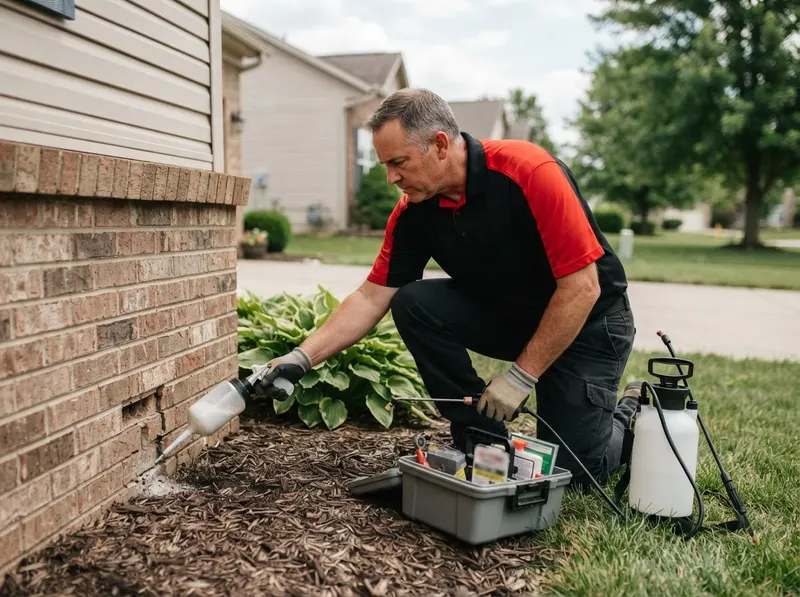
Suburban homes in Pinecrest, Sable Ridge, and Broadview Heights often rest on poured concrete slabs or crawl spaces bordered by decorative mulch beds. Organic mulch retains subterranean moisture that supports pavement ant colonies along patio pavers and garage expansion joints. Exterior management requires applying a calibrated liquid band 3 feet up the exterior brick or siding and 3 feet out onto the soil grade, adhering to standards from the National Pest Management Association. Structural gaps along basement utility penetrations, weeping holes, and window sills are treated with targeted non-repellent formulations that workers track directly into the parent nest. To prevent environmental drift near local waterways, outdoor applications follow drift-reduction directives managed by the Ohio Department of Agriculture Pesticide Regulation and runoff guidance from the USDA Natural Resources Conservation Service.
Effective protocols balance swift structural relief with ongoing biological exclusion. While indoor contact sprays kill visible foragers within 10 minutes, they leave the queen and subsurface broods intact, causing the nest to fracture into multiple distinct sub-units. Field applications prioritize non-repellent active ingredients such as fipronil or indoxacarb, which transfer through social trophallaxis across 7 to 14 days. Homeowners around the Farms at Jefferson and Blacklick Ridge facing chronic moisture issues must address foundation grades and gutter downspouts alongside chemical controls. For residences containing domestic animals, treatments comply with safe application thresholds detailed by the American Veterinary Medical Association and indoor ventilation parameters documented by the National Institute for Occupational Safety and Health.
Every job gets a firm, written price after an on-site visit.
Tell us about your ant management protocols job in Blacklick and we'll send a clear, written quote, usually the same day.
 ZephyrCrest Insect Protection