Autumn weather throughout Franklin County prompts aggregating insects to seek warmth along sun-exposed siding before migrating into interior living spaces. Overwintering stink bug & boxelder defense provides a barrier…
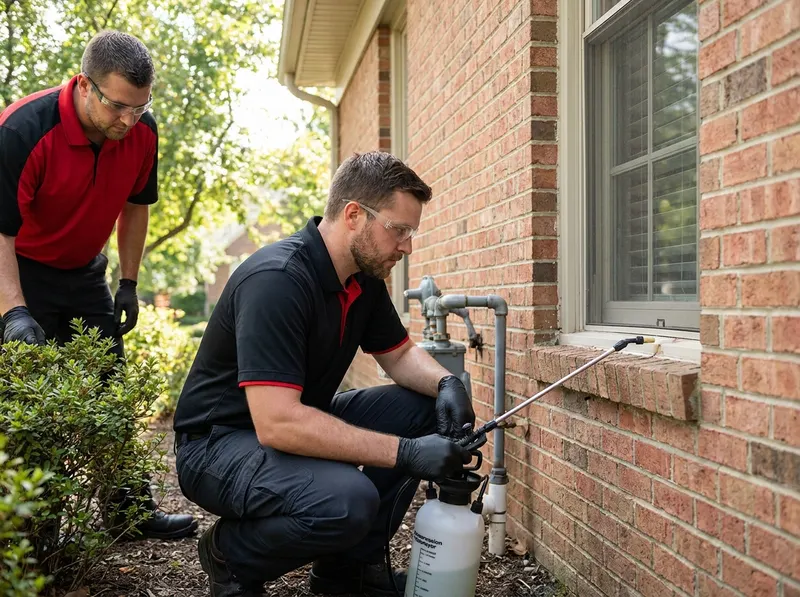
Autumn weather throughout Franklin County prompts aggregating insects to seek warmth along sun-exposed siding before migrating into interior living spaces. Overwintering stink bug & boxelder defense provides a barrier against two primary invaders: the brown marmorated stink bug and the boxelder bug. According to research from the Agricultural Research Service, stink bugs seek sheltered overwintering sites inside buildings when daily temperatures drop below 50°F. Properties near dense tree canopies, such as homes bordering the Blacklick Woods Metro Park or properties across Havens Corners and Broadview Heights, experience heavy seasonal aggregation on western and southern brick facades. Applying targeted perimeter exclusion prevents these pests from congregating under eaves, between vinyl lap joints, and behind exterior fascia.
Effective defense requires an outside-in scientific approach rather than non-selective indoor fogging. Field guidance from the Ohio State University Extension demonstrates that chemical sprays applied inside living quarters after insects have entered wall voids fail to address the primary entry points and cause unpleasant odors when dead insects decompose. Our perimeter treatments use residual microencapsulated formulations authorized under the Environmental Protection Agency regulations, which adhere to porous siding materials without staining trim. ZephyrCrest Insect Protection inspects architectural vulnerable spots like attic louvers, ridge caps, utility line penetrations, and window frame weeping holes common in subdivisions like Jefferson Run, Sable Ridge, and the Farms at Jefferson.
Homeowners choose between standalone fall defense applications and comprehensive structural exclusion programs. A targeted seasonal application fits homeowners who observe exterior crawling insects during warm September afternoons but have not yet found them inside upper-story bedrooms. The trade-off is seasonal timing: applying treatments too late in November after temperatures remain continuously below freezing leaves interior wall populations untouched until spring emergence. Following safety benchmarks established by the Centers for Disease Control and Prevention, all perimeter products are applied strictly to structural entryways, minimizing contact with lawn areas frequented by pets. Structural modifications adhere to guidelines defined by the National Pest Management Association to reinforce physical exclusion boundaries.
Executing timely physical and chemical barriers protects home insulation and preserves indoor air hygiene throughout the winter months. Property data from the Franklin County Auditor shows that multi-story homes in neighborhoods like Woods at Jefferson and Blacklick Ridge feature high roofline valleys where flying pests collect during October sunny intervals. Applying weather-resistant sealant to secondary access cracks and coordinating treatment along sun-exposed stone water tables prevents structural penetrations. For properties near riparian corridors along the Blacklick Creek Greenway Trail, pest managers reference soil conservation baselines from the Natural Resources Conservation Service and moisture mapping from the National Weather Service to ensure perimeter treatments remain intact during autumn precipitation cycles. Technical standards established by the Ohio Department of Agriculture govern our targeted placement on domestic structures.
Every job gets a firm, written price after an on-site visit.
Tell us about your overwintering stink bug & boxelder defense job in Blacklick and we'll send a clear, written quote, usually the same day.
 ZephyrCrest Insect Protection