Eastern subterranean termites cause structural wood failure by building earthen transit tunnels up foundation masonry to reach soft structural lumber. In Blacklick, residential architecture across Woods at Jefferson,…
Eastern subterranean termites cause structural wood failure by building earthen transit tunnels up foundation masonry to reach soft structural lumber. In Blacklick, residential architecture across Woods at Jefferson, Havens Corners, and Farms at Jefferson frequently features poured concrete foundations or crawlspaces set into moist, clay-heavy soils. According to guidance from the United States Environmental Protection Agency, effective suppression of soil-dwelling colonies relies on establishing continuous zones of treated ground rather than applying broad interior sprays. Field studies published by the USDA Agricultural Research Service demonstrate that subterranean foragers avoid repellent chemistries, which allows unseen structural feeding to persist through tiny untreated voids. To eliminate this risk, ZephyrCrest Insect Protection deploys non-repellent termiticides that worker castes unknowingly track through the central nest, transferring the active ingredient across the reproductive structure pursuant to protocols documented by the Entomological Society of America.
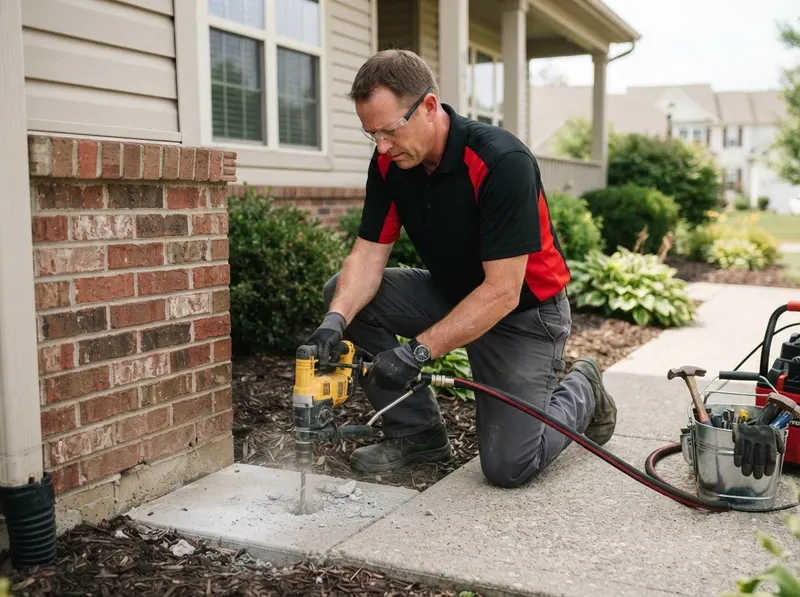
Remediation methods depend on foundation geometry and exterior hardscaping. Slab foundations in Broadview Heights and Blacklick Ridge often require sub-slab injection, where technicians drill 0.5-inch holes spaced roughly 12 inches apart through interior concrete to reach the soil grade beneath bath traps and perimeter seams. For crawlspaces and full basements adjacent to Blacklick Woods Metro Park and Turnberry Golf Course, trenching 6 inches wide by 6 inches deep along foundation walls allows liquid compounds to bind firmly with the subsoil. The structural integrity of sill plates must comply with load-bearing safety parameters tracked by the International Code Council, while soil application techniques align with standards published by the National Pest Management Association. Property drainage also impacts chemical longevity; gutter runoff diverted near footing walls dilutes residual treatments, violating surface protection measures monitored by the US Geological Survey and the Ohio Department of Agriculture.
Selecting between comprehensive perimeter barrier defense and baiting systems comes down to active infestation density and site geography. Liquid barrier trenching creates an immediate, continuous zone of protection around footings, which stops workers from crossing the foundation footprint. In contrast, modular bait stations installed flush with turf require foraging termites to locate cellulose monitoring matrices before toxicant introduction begins. A perimeter liquid barrier offers definitive structural protection when mud tubes are discovered along basement band joists, whereas baiting serves properties where extensive masonry patios or finished porches restrict soil access. Water table proximity near the Blacklick Creek Greenway Trail requires precise calculation of application depth to prevent leaching, adhering to environmental remediation standards defined by the Michigan State University Extension and the structural preservation guidelines of the Forest Products Society.
Executing subterranean termite remediation involves an orderly progression of structural diagnostics and chemical engineering. Step 1: Technicians conduct an acoustic and visual inspection of exterior sill plates, foundation masonry, and basement band joists to map mud tubes and moisture intrusion. Step 2: Excavators dig a shallow continuous trench along the exterior foundation perimeter, taking care to clear mulch and root barriers. Step 3: Injection rods introduce non-repellent liquid termiticide at calibrated volumes per linear foot down to the footing level. Step 4: Technicians drill hollow block voids and expansion joints adjacent to porches, saturating hidden transit routes. Step 5: Excavated soil is backfilled, treated, and tamped firmly back into position. Exact on-site measurements determine the precise linear material requirement before chemical dispersal starts, ensuring complete coverage without surface runoff. Questions regarding property inspections or scheduling can be directed to (380) 255-6032.
Every job gets a firm, written price after an on-site visit.
Tell us about your subterranean termite remediation job in Blacklick and we'll send a clear, written quote, usually the same day.
 ZephyrCrest Insect Protection